
Delivered.
Tuesday, November 15, 2011

Thursday, November 3, 2011
The great Partial Capo Experiment begins.
And so a very good man, Steve Cornish, did sell me a Third Hand capo this evening,
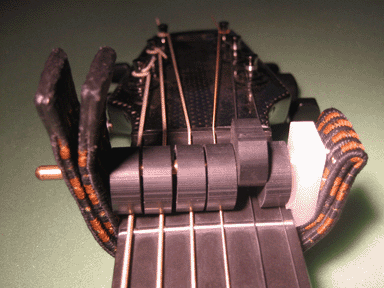
and verily I did place it upon my Ovation (strung to C2G2D3A3E4B3) in the initial position 220000, and began to play.
Oh dawggy, this is going to be an interesting ride.
I'm exhausted now--was tired when I started this, but like hell I was going to go to sleep without at least trying it out--but nonetheless tonight I tried 220000, 220002, and 001111. With the 220002 configuration I also brought the first string up a half-step so that the open pitches were DADAED, which was interesting to say the least.
Very eye-opening session. Harvey Reid is the primary advocate of the partial capo, and he seems to have a lot of ideas about how to use it. Most interesting for me is the concept that open pitches can be altered while notes up the neck remain the same, and you know what, that shit works! It opens up all kinds of open position fingerings you never thought of, while retaining the ability to play all the closed positions that you already know, up the neck. I was kind of expecting some cool factor on open string drones and bass notes, but I had not expected the impact it would have on melodic phrasing, especially in that "C-minor" centric arrangement of 001111. On the guitar (as opposed to the mandolin) the stretch to hit the m3 interval from a root note on the 5th fret of the next lower string is, indeed, a stretch, but with with a 001111 partial capo, you've got very comfortable access to that m3 and m7 and it's niice. Sure, technically you "lose" the major second, or rather you must now play it stopped on the root string, but this is a surprisingly easy tradeoff. My fingers just figured it out spontaneously, and then started playing things they don't normally gravitate toward. And then to go up the board you just...go up the board, find your root note, and play like you normally would. (Well...like someone who likes to tune the guitar in fifths would. :-)
Harmonics are going to be absolutely wild with this, and I suspect I'm going to have to just treat them separately for each possible configuration. Having an arrangement where the nodes offset each other from string to string is probably going to spawn some interesting stuff, and I look forward to it.
More to come. Just offhand I'm interested in checking out partial capoing over the third, fourth and fifth frets as well, and should start to experiment with some altered inner strings. Who the heck knows where it might lead?
Monster in the making. (Or, at least, inveterate geek.)
and verily I did place it upon my Ovation (strung to C2G2D3A3E4B3) in the initial position 220000, and began to play.
Oh dawggy, this is going to be an interesting ride.
I'm exhausted now--was tired when I started this, but like hell I was going to go to sleep without at least trying it out--but nonetheless tonight I tried 220000, 220002, and 001111. With the 220002 configuration I also brought the first string up a half-step so that the open pitches were DADAED, which was interesting to say the least.
Very eye-opening session. Harvey Reid is the primary advocate of the partial capo, and he seems to have a lot of ideas about how to use it. Most interesting for me is the concept that open pitches can be altered while notes up the neck remain the same, and you know what, that shit works! It opens up all kinds of open position fingerings you never thought of, while retaining the ability to play all the closed positions that you already know, up the neck. I was kind of expecting some cool factor on open string drones and bass notes, but I had not expected the impact it would have on melodic phrasing, especially in that "C-minor" centric arrangement of 001111. On the guitar (as opposed to the mandolin) the stretch to hit the m3 interval from a root note on the 5th fret of the next lower string is, indeed, a stretch, but with with a 001111 partial capo, you've got very comfortable access to that m3 and m7 and it's niice. Sure, technically you "lose" the major second, or rather you must now play it stopped on the root string, but this is a surprisingly easy tradeoff. My fingers just figured it out spontaneously, and then started playing things they don't normally gravitate toward. And then to go up the board you just...go up the board, find your root note, and play like you normally would. (Well...like someone who likes to tune the guitar in fifths would. :-)
Harmonics are going to be absolutely wild with this, and I suspect I'm going to have to just treat them separately for each possible configuration. Having an arrangement where the nodes offset each other from string to string is probably going to spawn some interesting stuff, and I look forward to it.
More to come. Just offhand I'm interested in checking out partial capoing over the third, fourth and fifth frets as well, and should start to experiment with some altered inner strings. Who the heck knows where it might lead?
Monster in the making. (Or, at least, inveterate geek.)
Wednesday, October 19, 2011
Trick question.
Question: What's the most amazing thing about this new vid from Antoine Dufour?
Pause, for a moment, to pick your jaw up off the floor. (It always takes me a minute. :-)
Answer: it fades out. To me, that can only mean one thing: he wasn't satisfied with how he concluded the piece.
Somehow, that just strikes me as riotously funny.
Pause, for a moment, to pick your jaw up off the floor. (It always takes me a minute. :-)
Answer: it fades out. To me, that can only mean one thing: he wasn't satisfied with how he concluded the piece.
Somehow, that just strikes me as riotously funny.
Sunday, September 25, 2011
Ovation's now in CGDAEB
That is, C2 G2 D3 A3 E4 B3. In playing a bit with it tonight (brain dead) I found myself making more use of the B3 than the C4, outside of harmonics in Am (and those do sound lovely). I've tasked Steve Cornish with acquiring a couple of partial capos, including the single- and double-outside string models and the Third Hand, so the Great Partial Capo Experiment can get underway. A lot of possibles there, including a D-centric capo on 2 2 0 0 0 0 (or, for an open Dm7, 2 2 0 0 1 1). Interestingly, I found that barring the F and C notes on the first and second strings and then slapping the harmonics gave me a lot of what I was looking for in the first place, although there are definite timbre differences between slapped and popped harmonics and I'd probably want to have access to them both.
I've got a funny feeling about this tuning, with partial capos. It will be this that I use to go through Scott Tennant's book Pumping Nylon, to build up a little competence with fingerstyle playing, and it will be interesting to see how things develop. I do know where those notes are in fifths, and having that first string lower than the second is interesting in the "upper" voicings.
Strings are phosphor bronze, 59w - 46w - 30w - 22w - 12p - 16p. I'm once again tempted to try electric flatwounds and see how they play as well. If I'm adopting a lighter style and amplifying it, this may be of minor concern.
Onward. Let's see what happens!
I've got a funny feeling about this tuning, with partial capos. It will be this that I use to go through Scott Tennant's book Pumping Nylon, to build up a little competence with fingerstyle playing, and it will be interesting to see how things develop. I do know where those notes are in fifths, and having that first string lower than the second is interesting in the "upper" voicings.
Strings are phosphor bronze, 59w - 46w - 30w - 22w - 12p - 16p. I'm once again tempted to try electric flatwounds and see how they play as well. If I'm adopting a lighter style and amplifying it, this may be of minor concern.
Onward. Let's see what happens!
Friday, August 19, 2011
Another tuning thought: what about CGDAEC?
A quick post to document a thought that hit me last night.
What about C2-G2-D3-A3-E4-C4?
Disadvantages:
I will have to try this out. Since I don't have years of fingerstyle under my belt yet, it may be that I can adapt to this easily enough to take advantage of the benefits. The more I think about it, the more interesting it seems: the first string is the only thing that ever "moves", and yet it seems like there are four very individual tunings there.
What about C2-G2-D3-A3-E4-C4?
Disadvantages:
- First string is lower in pitch than the second; which could theoretically get confusing.
- Without a fourth interval between the second and first strings, you do lose that beautiful ascending V-I option (especially with harmonics).
- Low C may be optimistic with nylon strings (but is fine for steel).
- All the fifths relationships of the Guitar Craft tuning (C2-G2-D3-A3-E4-G4). Two complete four-string groups in fifths, allowing lots of fifths-based scale thinking and chord construction with no need to "skip strings".
- For fingerstyle, a minor triad on the top three strings. With this voicing, at least some common alterations may present very convenient left-hand fingerings.
- First and sixth strings are two octaves apart. Lots of people playing standard tuning and DADGAD take advantage of this.
- The first string becomes a simple pivot between CGDAEC (root position Am triad on top 3 strings) and CGDAEB (GAD intervals on top 3 strings). Or, for that matter, CGDAEC# (A major triad) or even CGDAED (which is theoretically another GAD variation). Total retuning movement for the first string here is a minor third--very do-able--and well within the range of appropriately-gauged strings. And, the GAD variations re-capture the ascending V-I arrangement.
- The possibles of using these intervals with partial capoing seem immense, almost intimidating--and yet above whatever capo(s) are placed, I've still and always got five strings in fifths to work with.
I will have to try this out. Since I don't have years of fingerstyle under my belt yet, it may be that I can adapt to this easily enough to take advantage of the benefits. The more I think about it, the more interesting it seems: the first string is the only thing that ever "moves", and yet it seems like there are four very individual tunings there.
Tuesday, August 16, 2011
Django and Stephane.
Say what you want about YouTube--it's probably true. But this--this--has to go way, way up in the plus column:
Just magnificent.
And because I'm just so fond of the tune, here's audio of Minor Swing:
What a treasure. Two of the most important musical influences of the twentieth century, and you can immediately see and hear why.
Rest in peace, fellas. We miss you.
Just magnificent.
And because I'm just so fond of the tune, here's audio of Minor Swing:
What a treasure. Two of the most important musical influences of the twentieth century, and you can immediately see and hear why.
Rest in peace, fellas. We miss you.
Monday, August 8, 2011
Kaki King, stylist.
There is a reason this woman is such an important stylist. More than anyone else in the "percussive acoustic" genre that I've heard thus far, she throws in unexpected little phrases that are unsettlingly "not right", and yet they are perfect. If you only heard it once, it would be tempting to call it an elegantly-handled mistake (via Tom Redmond: "If you play a wrong note, play it again"), but no, this happens too often to be unintentional.
The following contains a couple examples of this, and is otherwise just a beautiful piece, excellently played. She lulls you in, and then hits your ears with a "wait, what was that?" and then is back. It's a nice touch here, too, on a reasonably conventional fingerstyle composition.
The more I hear from King, the more that I hear this as what makes her unique among her peers. You get the same sort of thing in her flashier, percussive work, or in her brooding improvs--all of it. I think at some level I just like her particular choice of dissonances (and love the fact that she seems to improvise them), but still: when the "wait, what was that?" question arrives from the ears to the brain, it's reliably King who is playing.
Flat picker Dan Crary has long impressed me with his stylistic signature of inverting the third in a common tune, after the melody has been firmly established: suddenly, he's playing the same piece in parallel minor, which is a really nice aesthetic touch in bluegrass, and he'll usually return to the original arrangement to close out. It's a simple device, really, but Crary has made it a recognizable style point, and it's almost always effective without being ham-fisted or even "leaving the genre". What King does strikes me as very similar, but she'll charge right out into chromatic territory without warning (rather than employ airbrakes with more "tonal approaches" like parallel substitutions and quick modulations), and, well, your ears just need to keep up. That can very, very easily fall flat on its face, or quickly get cliched and predictable (e.g., if the chromatic phrase always leaned on the flat-five), but somehow King avoids it, and it usually works.
I'm impressed, and aspire.
The following contains a couple examples of this, and is otherwise just a beautiful piece, excellently played. She lulls you in, and then hits your ears with a "wait, what was that?" and then is back. It's a nice touch here, too, on a reasonably conventional fingerstyle composition.
The more I hear from King, the more that I hear this as what makes her unique among her peers. You get the same sort of thing in her flashier, percussive work, or in her brooding improvs--all of it. I think at some level I just like her particular choice of dissonances (and love the fact that she seems to improvise them), but still: when the "wait, what was that?" question arrives from the ears to the brain, it's reliably King who is playing.
Flat picker Dan Crary has long impressed me with his stylistic signature of inverting the third in a common tune, after the melody has been firmly established: suddenly, he's playing the same piece in parallel minor, which is a really nice aesthetic touch in bluegrass, and he'll usually return to the original arrangement to close out. It's a simple device, really, but Crary has made it a recognizable style point, and it's almost always effective without being ham-fisted or even "leaving the genre". What King does strikes me as very similar, but she'll charge right out into chromatic territory without warning (rather than employ airbrakes with more "tonal approaches" like parallel substitutions and quick modulations), and, well, your ears just need to keep up. That can very, very easily fall flat on its face, or quickly get cliched and predictable (e.g., if the chromatic phrase always leaned on the flat-five), but somehow King avoids it, and it usually works.
I'm impressed, and aspire.
Subscribe to:
Posts (Atom)
