Monday, April 2, 2012

Wankery with BbFCGDG

Spent a little time with Bb1-F2-C3-G3-D4-G4 again today, both open and with partial capos (003333, 033333, 001111, and 444400.  I think I'm going to like this tuning.

Started working with Scott Tennant's Pumping Nylon, and I think that book is going to be a big eye-opener for some right hand techniques.  My fingers are starting to find some comfort in scale runs, but studying Tennant's work may be a quicker path there.  Very well, exercises then.  Not a bad thing.  :-)

Tried to pick up the G-major Bach Cello Prelude again and some of it fell quite naturally into the fingerstyle idiom.  I think it may be good for me to get a couple of old tunes back into the fingers with this new style, in addition to the structured exercises and some good old fashioned wankery.  At some point (soon, I hope) I'll start to put some recording mojo into place.  (The upstairs office is only a session or two away from this possibility, and I'm starting to taste it.)

Anyway, to document.  Tonight I spent most of my time in minor mode, trying to feel fingers, rhythm, transitions, and movement between techniques (slap harmonics, straight notes, popped harmonics, rasgueados, etc.);  there's a lot just in there that I'll have to pay attention to.  But it's coming.

Thoughts: 
  • Keep the classical in standard tuning, at least through working with Tennant's book.  
  • Until reconfiguring as a 5-string, string the Guitalong in 6 nylons, D3-D2-A2-E3-B3-E4, standard string set with "4th string" on 6,  "6th string" on 5, and "5th string" on 4.  Give that a shot.
  • I'm liking the idea of working up the SoloEtte as "do-all" instrument, with GraphTech Ghost system and one or two mag pickups for ebow.  That could be a nice arrangement.
Now:  sleep.

Saturday, March 31, 2012

Still here.

Lots of ideas right now, but little discipline.  That should change fairly quickly, as I was reminded that there is an ongoing open mic at Alice's recently, and it would be wise of me to make sure that the girls, at least, start to see more of Dad up on stage.  That may be an adequate rallying cry to get things moving;  whatever it is, I'm game. 

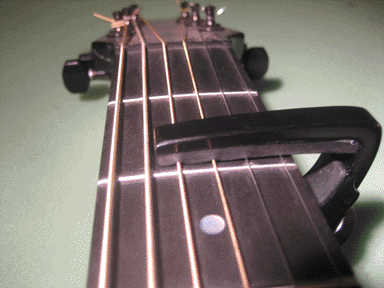
Recently got hold of a Planet Waves "Trio" partial capo, which is good for either four or five outer strings:


Based on the limited look I've given it so far, this may become a real workhorse.  Capoed 001111 in the C2-G2-D3-A3-E4-B3 tuning I've had the Ovation in lately, that makes a really nice open Cm11 with roots on sixth and first strings, with some lovely minor intervals for the offset harmonic nodes.  Then, today, testing out a new tuning Bb1-F2-C3-G3-D4-G4 capoed 003333 on the SoloEtte (for a Bbsus across open strings and more open intervals across the offset harmonic nodes), I was struck again at how nice it is to have predictable notes above the capo.  Going back to the Ovation, I turned things around and capoed 444400 (which would be what, E6/9 I think?  It's late) and quickly found some really nice major mode territory to play with.  Yeah, I think I'll like this 4-stringer.

Need to order the 1- and 2-string "G-Bands" for capoing one and two outer strings, and get the Shubb "Esus" partial capo for stopping three adjacent inner strings.  With those four capos in the arsenal, along with the Third Hand, one should be able to do everything that you can do with a partial capo, and I'm looking forward to trying them all out.  It's a nifty idea!

Wanted to document the tunings I'm currently working with, so I don't forget:
  • C2-G2-D3-A3-E4-B3.  All fifths, but with the wrinkle of the first string being lower than the second.  Jury's still out on this one in the melodic sense, but harmonically it is really nice having three four-string groups all in fifths, and the top four strings now put the third degree on top in the most convenient "root inversion" shape.  And that 001111 partial capo is intoxicating.
  • Bb1-F2-C3-G3-D4-G4.  Huge range, but starting to get funky with string gauges.  Even with a 59 on the sixth string, that's a bit floppy, and on the other hand that high G (the same G that the Guitar Craft uses for the first string and twelve-stringers use for the third-string octave) is either too tight for good slap harmonics, or might start to lose real volume with a suitably tiny string gauge.  (The second-octave and major-third harmonics on the G string, capoed up to Bb, are some high notes.  :-)   Jury's out on this one too, but I'll play with it some more.  Melodically I do like that fourth "on top", because if your root note is the open first string, the second string is the fifth degree, down.  That's got some conveniences.
  • D3-D2-A2-E3-B3-E4.  This one occurred to me today, for nylon-string instruments, whose string-gauge requirements are much more of a challenge than steel-string ones.  The idea is to have a core four-string group, all fifths, in the middle, for melodic work and basic chord construction, letting the sixth and first strings perform outlier tasks.  The first string is a fourth up from the second, giving that V-I option that is such a strength of standard tuning, and also enabling both convenient power chords as a 3-string barre over 1-2-3 and also convenient octaves on 1 and 3 (that latter sounds nice).  The sixth string, on a nylon, is just not going to go down to G1 (nor is the first string going to go much above E4), so why not make that an octave too, a la the "Aerial Boundaries" tuning but in reverse?  I'll string up the beater classical with that arrangement and see how it goes.
Okay, time for sleep.  Got some ideas for re-purposing the instruments into different roles, and it seems that the next instrument that I will need will be a twelve-string--based on a little poking I did while on a recent trip Outside.  Again, many ideas, little time, and less discipline.

Time to change that.  Some of these ideas are worth pursuing.  :-)

Tuesday, March 27, 2012

Sartori in Tangier: documenting a wee bit o'Crim.

Ran into this late last night, when I needed some real, honest-to-God noise.

Wow.  Robert delivers.


I've always loved this tune, even before I ever heard a live recording of it.  And then, when I finally did...well, there is just no preparing for what you see when you watch the 80s King Crimson do this piece live.  The first time I did, my internal monologue went something like this:
Wait, Belew's on drums?  But the whole theme is there...no, Robert's not playing anything yet...holy shit, that's all Tony?  What the...yes, yes it is.  Okay then, who's going to play the keyboard part?  Okay, there it's winding up, but who's doing it?  Robert's nowhere near a key-...oh, he's playing it through the guitar?  Yeah, well, that's kind of like the sound on the record, or rather it was a minute ago before he added another power grid's worth of "live wire" sound on his way up the ramp...and HFS, just look at him go!  Either he's going to pop an aneurysm, or I am, because this is just unbelievable.
At the time I had no idea what a guitar synthesizer was, and the only live Crimson I'd heard before was of the '70s band, which featured an actual keyboard (Mellotron), so I was just not ready for those sounds to go with that picture.  But hell, there they were, and anyone who has heard both the studio recording and any live performance from that period can tell you they are two completely different animals.  While absolutely being the same tune.

There's a lot of King Crimson that works well--really well--when my head needs to just light off a flamethrower and torch noise with noise.  "Sartori" is at least near the tippy top of the heap, and may actually rest there.  Here it is, as a document, if nothing else.

Tuesday, March 20, 2012

Soul food...for a week, at least.

Pardon my French, but fuck a duck.


Just listen.  Closely.  With attention.  And marvel at what human beings are capable of.  The phrase, "that band is tight" is simply wholly inadequate to describe what happens here.

The unaccompanied piano solo is a masterpiece;  by itself it will eat your brain while it feeds your soul. The band's re-entry and continued piano feature is magnificent;  these gents are smooth.  Then, just when you think they're spent, there's one of those capital-M moments between Cohen and Guiliana, even with the rock'n'roll style crescendo:  you get both!

This performance is much less about the tune than about the improv, which in one way is a bit of a shame, since "Nu Nu" is such a strong melody and groove, but hell, there are other performances that showcase that.  (For the original recording with "lead oud", go here;  for a great balance between the tune and the blowing, try this one.)  It's not every band that will really hang it out there on the improvs, but this trio will do it--bless 'em--and if YouTube is any indication, they can smoke.

This is one of the strongest groups I've seen in a long time.  Check out their command of eleven in this thoroughly beautiful piece:


I have got to get the chance to see them live.  Gah, now I'm inspired.

For at least a week.  :-)


Tuesday, November 15, 2011

Antoine Dufour - Cold Day

I just flat needed to hear something spectacular tonight.

Delivered.


Thursday, November 3, 2011

The great Partial Capo Experiment begins.

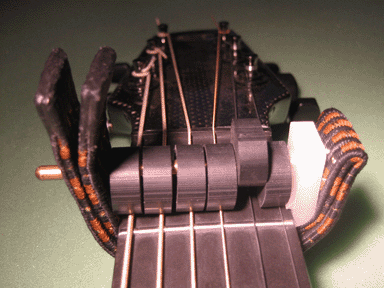
And so a very good man, Steve Cornish, did sell me a Third Hand capo this evening,


and verily I did place it upon my Ovation (strung to C2G2D3A3E4B3) in the initial position 220000, and began to play.

Oh dawggy, this is going to be an interesting ride.

I'm exhausted now--was tired when I started this, but like hell I was going to go to sleep without at least trying it out--but nonetheless tonight I tried 220000, 220002, and 001111.  With the 220002 configuration I also brought the first string up a half-step so that the open pitches were DADAED, which was interesting to say the least.

Very eye-opening session.  Harvey Reid is the primary advocate of the partial capo, and he seems to have a lot of ideas about how to use it.  Most interesting for me is the concept that open pitches can be altered while notes up the neck remain the same, and you know what, that shit works!  It opens up all kinds of open position fingerings you never thought of, while retaining the ability to play all the closed positions that you already know, up the neck.  I was kind of expecting some cool factor on open string drones and bass notes, but I had not expected the impact it would have on melodic phrasing, especially in that "C-minor" centric arrangement of 001111.  On the guitar (as opposed to the mandolin) the stretch to hit the m3 interval from a root note on the 5th fret of the next lower string is, indeed, a stretch, but with with a 001111 partial capo, you've got very comfortable access to that m3 and m7 and it's niice.  Sure, technically you "lose" the major second, or rather you must now play it stopped on the root string, but this is a surprisingly easy tradeoff.  My fingers just figured it out spontaneously, and then started playing things they don't normally gravitate toward.  And then to go up the board you just...go up the board, find your root note, and play like you normally would.  (Well...like someone who likes to tune the guitar in fifths would.  :-)

Harmonics are going to be absolutely wild with this, and I suspect I'm going to have to just treat them separately for each possible configuration.  Having an arrangement where the nodes offset each other from string to string is probably going to spawn some interesting stuff, and I look forward to it.

More to come.  Just offhand I'm interested in checking out partial capoing over the third, fourth and fifth frets as well, and should start to experiment with some altered inner strings.  Who the heck knows where it might lead?

Monster in the making.  (Or, at least, inveterate geek.)

Wednesday, October 19, 2011

Trick question.

Question:  What's the most amazing thing about this new vid from Antoine Dufour?


Pause, for a moment, to pick your jaw up off the floor.  (It always takes me a minute.  :-)

Answer:  it fades out.  To me, that can only mean one thing:  he wasn't satisfied with how he concluded the piece.

Somehow, that just strikes me as riotously funny.