Tuesday, October 30, 2012

Tuck Andress, ninja master.

Hotel Foxtrot Sierra, how is it that I have not paid any attention to Tuck Andress until now?

I need to document the series of YouTube videos that someone has made from what must have been a VHS tape.  They are phenomenally dense, in terms of what they present;  Andress has a master instructor's poise and delivery, which wholly aside from his jaw-dropping guitar mastery is simply impressive to watch.

The first video is here:


Other ones in the series seem to go to volume nine, and those were all just gold-mines of information.  This short captures an example that Andress makes of his technique of playing multiple parts at the same time:


The guy really is a Jedi Master of guitar-fu.  And in addition to all the instructional stuff, it's equally inspiring just to watch him play:


Well.  If it took me this long to discover this resource, I'll damn sure see if I can make the most out of the discovery now.  :-)

Diatonic scales with CGDEbGC

Another documentation post, really.  In working with this open minor-add-9 tuning (C-G-D-Eb-G-C) I've been exploring the top three strings somewhat methodically, which is a bit amusing since the intervals of Eb-G-C are the same as the standard tuning (G-B-E, two whole steps up), and I've never really studied the standard tuning yet.  Which has led to an observation I'll get to shortly.

First was triads on these strings, done within my usual "box" of three voicings per triad, advancing each string one chord tone to achieve it.  So, in this tuning, at the nut is C/E, C/G is at the fourth and fifth frets, and C in root inversion is at the seventh and ninth frets...et cetera.  Shortly I was running through a standard exercise that has me play, up and down, backward and forward, the C major scale in triad forms, from nut to octave.  So:  C/E, C/G, C, then Dm/F, Dm/A, Dm, then Em/G, Em/B, Em, and so on.  Along with each of the main forms I also tried to note where the sus4 would go, and I'm pretty comfortable that this will shortly become a standard part of the internalized chord library.

Then, I tried adding bass notes to these basic forms, to try and figure out where the fingerings should go.  This is an interesting exercise, since there is often a choice of where a bass note can or should be located, and I'm not by any means done with it yet.  Inadvertently, the little working I've done so far has suggested a specific approach to diatonic seventh forms, wherein the chord is constructed of an appropriate bass note and an appropriate top triad.  This brings back the "tertian arithmetic" idea in a very practical way, and I'm happy to think of a Cmaj7 as an Em triad over the C3 note on my fifth string, or the C2 open sixth...or maybe the Em triad in up-neck inversions over the C4 note on the fourth string.  And that's just with root inversions;  I think I'll dig into that a little more when the library of top-three-string triads becomes more purely autonomic.

It also suggests an interesting idea with respect to tunings:  if I really can master the basic triad and sus forms on the standard tuning's intervals in the top three strings, I might be able to shift the bottom three strings around more at-will, to make available a family of tunings with a common set of top intervals.  So...with a real mastery of "GBE" chord construction, I could take advantage of fifths in the bass with CGDEbGC or CGDGBE, fourths with EADGBE or DGCEbGC (or similar), or a combination like DADFAD.

Which brings me to today.  I was able to work out the seven modes of the major scale on the top three strings, which of course is a great exercise to start to help you to "see" all the notes of the key everywhere on the neck.  I've still got a few fingering decisions to work out, or perhaps to learn them all so that they'll all be available depending on what else I'm doing at the time.  More work on up and down, backward and forward:  my fingers should tell me what is going to be most efficient.  What was encouraging was that I also started to see how I could connect a "lower octave" scale from the bottom three strings, to the "upper octave" scale on the top three strings.  The basic concept here might do well with that "family of tunings with differing bass strings" idea.

More on that as soon as I can.  With the ability to play all the triads and sevenths of a key, and the ability to play all seven modes of the scale, we're really getting somewhere important.  With that in hand, plus the ability to take advantage of the harmonic mayhem of a minor-second interval between fourth and third strings, I should become pretty dangerous in this wacky experiment.  :-)

Sunday, October 7, 2012

Working with CGDEbGC

A bit of a documentation post here.  After some nice experiments with the DADFAD tuning over the summer, I somehow ran across the idea of CGDEbGC, and have been quite enjoying it.  This tuning has some interesting features:
  • Top three strings are standard tuning intervals.
  • Bottom three strings are the fifth intervals I know from Guitar Craft.
  • The two three-string groups are offset by a minor second (D-Eb).
  • Sixth and first strings are two octaves apart.
  • Fifth and second strings are one octave apart.
  • Open, the tuning is a Cm add9, which is nice.
  • There is an entire G harmonic minor scale in harmonics available on the fifth, fourth, third and first strings;  if you omit the subdominant note (the first harmonic on the first string) this is extremely convenient to the fingers.
Obviously there are going to be some interesting options in chord construction, but I'm not fully there yet.  I think I might get around to it, though--some of the sounds are just gorgeous.  This last week I've turned my attention to the triads on the top three strings (remember, I'm actually new to standard tuning), and thought about how to incorporate a bass note intelligently.  In that regard, having the fourth string offset a whole tone above the first string (D to C), instead of below (as with D to E), it seems more comfortable to finger the three-string triad with middle, ring and pinky fingers and leave the index finger to find the bass note, rather than relegating that role to the pinky.

Melodically, I'm finding that I'm gravitating toward the "ignore the third string" philosophy, and thinking of the basic minor scale in terms of fifths intervals for the first octave and fourths intervals for the second.

The next step with chords, once I've really got the triads down, is to tackle sevenths.  I suspect that is where I'll find out whether this can be a general purpose tuning, or should be relegated to tunes specifically composed to take advantage of it.  Depending on how the fingerings work with that fourth string, I may look at solving the problem with a polychord approach, and I admit that forcing myself to use that concept as a core portion of my playing might not be a bad thing at all.

In addition to the ongoing tuning thoughts, I've been working a little bit more deliberately on a controlled three-string burst with the right hand, ascending (i-m-a).  For whatever reason, my fingers have always seemed to be pretty comfortable with such a cascade descending (a-m-i), but I've been impatient with the reverse and haven't given it the attention it deserves.  In trying to incorporate it into my triad work on the top three strings, my ear has something much more specific to focus on and it's suddenly started to improve. 

Yay!

Wednesday, September 19, 2012

Strength in Numbers on YouTube

More documenting.  Again from YouTube, this old jewel about newgrass supergroup Strength in Numbers, which features a rousing performance of "Blue Men of the Sahara" starting at 2:38.


I first saw it on a VHS in the early days of my attending the Telluride Bluegrass Festival, and of course what immediately struck me about the performance was the interplay between Edgar Meyer (bass) and Mark O'Connor (fiddle).  Edgar is full "goad mode on" here, and O'Connor just tears it up.

At the time, my wife (who wasn't exactly heavy into bluegrass) commented that that fella may look like a truck driver at first glance, but then he does things you don't usually expect truck drivers to do.

And then some.  O'Connor does things you don't usually expect mortal human beings to do.

Shakti on YouTube

Documenting.  By one of those glorious accidents, I ran across a YouTube of Shakti from 1974, and as one might imagine it deserves to be noted here.


God, I love YouTube.

And that's just about what I'd have expected to see, to go along with those precious and magnificent audio recordings.  The greatest fault with the original Shakti is that there was not more of it.

Among those things that came along and just knocked my musical ear right on its very ass, Shakti rates among the highest;  unlike most folks I know, I don't consider the Mahavishnu Orchestra to be the crown jewel of McLaughlin's substantial career.  No offense to that great project, but I'll take Shakti any day.

Saturday, August 18, 2012

Still here...

...and for the first time in a long while I got some good time--that is, time enough actually to start listening--in with an instrument.  In this case it was the SoloEtte, still tuned in DADFAD, through the iPhone and the Line 6 MobileIn interface.  (The open minor seems to suit me pretty well.)

Very percussive feeling today--most likely some frustration working itself out.  A few discoveries about the tuning's geometries, which hopefully I'll be able to follow up on soon.  Also some hand mechanics fell a little more into place;  based upon John Danley's Satori being stuck in my head, I learned a couple of things about the Preston Reed-style "over the fingerboard" left hand which are intriguing.  (I may have to study Tractor Pull a little more.  :-)

Episodes like this seem to serve two purposes.  First, they frustrate me greatly as I am reminded that the state of being "all ideas, no discipline" is severely limiting.  Gah! 

On the other hand, they also can fuel me so that I can survive these agonizingly long periods between sessions.

Tuesday, June 5, 2012

iPhone thoughts.

A while back, when I first found out about the Alesis iO Dock, I started thinking about the iPad as the centerpiece of a minimalist do-it-all rig, that would suit what I (think I) want to do.  I still think it's a pretty good idea, and Alesis' new AmpDock seems to be a step above the iO Dock in several very important respects.  Had I an iPad of my own, I'd probably already be down that path.

Here, about a year later, due to a couple of really interesting discoveries and my first week on the road in several years, I'm starting to think about the iPhone as well.  First, and the software centerpiece of the idea, is the FourTrack app from Sonoma Wire Works:


Now if I'm reading everything right, this is one nifty app;  it's not just an app in a vacuum but a framework for plugging in other related apps like loops, FX, etc., and hopefully (more on which in a moment) hardware.  It strikes me as well-designed and easy to use, based on the YouTube presence (just consider this one, done by a user rather than by Sonoma itself.).  Oh yeah, and it's five bucks for all the starter stuff.  (Thus far it does not appear that people have been complaining that you have to make lots of in-app purchases to do meaningful things, which can be a gotcha with iOS apps in general.)  Sonoma also offers GuitarTone (an FX/modeling app with a free core and available paid upgrade plugins, which both works standalone and as a "tool" within FourTrack), several variants of the InstantDrummer app (creates drum patterns/loops and is also a "tool" within FourTrack, at $3 per "style" specialty), and even a boutique partnership app called Taylor EQ (like GuitarTone, also a standalone app and FourTrack "tool";  this one offers EQ to emulate or cement the Taylor guitar sound).  The set of apps also has the capacity for "audio copy/paste" and offers a creative way to conveniently get at your sound files for reprocessing in a traditional software DAW.  (Being a software developer myself, some of these tricks not only promise great functional utility, but actually endear the company to my "scrapper-friendly" aesthetic.)

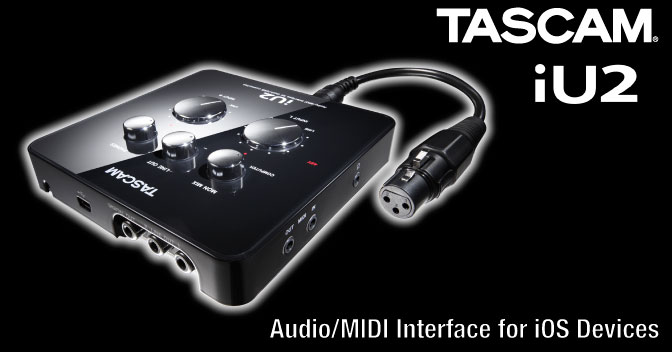
This seems to solve, for me at least, the problem of some sort of serious competition to GarageBand in terms of being able to do both FX and basic multitrack recording at the same time.  For this, it needs only a serious hardware interface, and although Sonoma's own GuitarJack seems solid and well-regarded, and truly able to do much of what I would want to do on an iPhone (especially on the road), last night I stumbled onto the Tascam iU2.  Check this out:


This little box, through some creative cabling and switching, offers two simultaneous inputs for either 1/4" or XLR cables, optional phantom power, internal preamps, mic/line selectors (or a guitar DI on the left channel), standard MIDI I/O, RCA and digital outs, direct monitoring--in short, a usable 2x2 hardware interface.  Here's where it gets really interesting, though:  this unit can deliver to an iOS device through an external dongle for the 30-pin dock, or can go via USB to a computer like a traditional recording interface.  When connected to the computer, it's powered by the computer's USB cable;  when connected to the iOS device, it's device-powered--and you can take the device's power brick and hook it into the iU2's USB port, in which case your device's AC brick recharges the device through the iU2.  Now that's clever, and useful. 

So:  if you have access to a computer for recording, you can use that (like the PreSonus AudioBox USB I'd figured I'd get someday, which offers basically the same input features);  if you are fully portable or on the road, use the same box to go directly into the device.  It seems to have a nice small footprint:  4.4" square and not an inch thick;  it looks to be hardly larger than the Pandora PX4 I carried around for so many years on the road, but coupled with the iPhone it's tremendously more powerful.  And at $150 or so, it looks like once again I may be able to pay less and get more.

I have not validated yet that the Sonoma apps will recognize the iU2, but I'm hopeful. If I'm on the road enough, it may be worth it to me to also get the GuitarJack and the recommended microphone just for the ultimate in compactness, but after playing a bit with Line 6's MobileIn interface, I'd always prefer a separate dock dongle to something that puts angular tension on the device's docking port.  (I'd make an exception for the iM2 stereo iOS microphone, which won't have a 1/4" guitar cable dangling off the end;  I'm also hopeful that the Sonoma apps will recognize that hardware as well...it should be great for minimalist acoustic instrument or ambient recording.

Food for thought.  It's exciting...and getting cheaper, smaller, and better.  Technology's fun, isn't it?

__________________________
For anyone who might stumble across this post:  if you have contributory opinions I'd love to hear them.  How are Tascam preamps regarded, compared to PreSonus'?  Any serious loss of quality expected from the "converter" cables that take MIDI and XLR  to 1/4"?  And for that matter, how about the RCA line outs;  any difficulties or problems with those?  Anyone have personal experience or knowledge about the Sonoma apps?  Are the above ideas totally off the rocker?  What is the airspeed velocity of an unladen swallow?  (We never did get a good answer to that, did we?  :-)